1. Introduction: Why Do Some People Always “Overthink”?
In interpersonal relationships, some people seem to notice details faster than others. When a friend’s reply becomes slightly colder, they may immediately wonder whether they have said something wrong. When someone remains silent for a short moment during a conversation, they may quickly feel uneasy. A single look from a teacher, supervisor, or friend may be repeatedly analyzed in their mind. For these people, the world is not a quiet background. It feels more like a field filled with signals: facial expressions, tone of voice, silence, atmosphere, emotional distance, light, and sound are all quickly detected and brought into thought.
In everyday language, this experience is often described as being “sensitive,” “fragile,” or “overthinking.” However, from a psychological perspective, it is not necessarily a personality flaw or simple emotional weakness. It may be related to a psychological trait known as Sensory Processing Sensitivity, SPS. Aron and Aron systematically studied this concept in 1997. They defined SPS as a relatively stable individual difference, characterized by greater sensitivity to both external and internal stimuli, as well as a tendency toward deeper information processing. They also noted that although this trait is related to introversion and emotionality, it cannot be simply equated with either introversion or neuroticism.
Therefore, the central question of this paper is: How can highly sensitive people process the information they receive in a reasonable and healthy way? In other words, how can they move from “being dragged around by sensitivity” to “using sensitivity to understand the world more accurately”? This paper discusses the origins, functions, difficulties, and transformation of high sensitivity under the theme of “from sensitivity to perceptiveness.”
2. What Is High Sensitivity?
High sensitivity is not a mental disorder, nor is it simply a form of weakness. In psychology, it is usually understood as a personality or temperament trait. Highly sensitive people tend to notice changes in their environment more easily and to process these changes more deeply. In their 2012 review, Aron, Aron, and Jagiellowicz pointed out that SPS involves heightened responsiveness to environmental stimuli and can be understood from the perspectives of evolution, biological responsivity, and individual differences in personality.
High sensitivity is often explained through the DOES model:
| Element | English | Meaning |
|---|---|---|
| D | Depth of Processing | Deep processing; a tendency to think repeatedly about the meaning behind events |
| O | Overstimulation | Becoming easily overwhelmed in noisy, complex, or high-pressure environments |
| E | Emotional Reactivity / Empathy | Strong emotional reactions and empathy; being easily affected by others’ emotions |
| S | Sensitivity to Subtle Stimuli | Sensitivity to subtle information, such as tone, facial expressions, atmosphere, sound, and light |
This shows that high sensitivity is not a single behavior, but rather an entire way of receiving and processing information. The problem for highly sensitive people is not that they can sense many things. The real difficulty is that they receive too much information and often enter deep processing automatically.
3. How Common Are Highly Sensitive People?
In earlier popular discussions, it was often said that highly sensitive people account for about 15% to 20% of the population. Later research, however, proposed a more nuanced classification. In a 2018 study, Lionetti and colleagues examined a sample of 906 adults using the HSP scale. Through a data-driven method, they divided people into three groups: highly sensitive individuals accounted for about 31%, medium-sensitive individuals about 40%, and low-sensitive individuals about 29%. The researchers used the metaphors of “orchids,” “tulips,” and “dandelions” to describe people with different levels of sensitivity.
| Type | Proportion | Metaphor | Characteristics |
|---|---|---|---|
| Highly sensitive | About 31% | Orchid | More strongly responsive to environmental changes |
| Medium-sensitive | About 40% | Tulip | Between high and low sensitivity |
| Low-sensitive | About 29% | Dandelion | Relatively less responsive to environmental changes |
This suggests that sensitivity is not a simple matter of “having it” or “not having it.” Rather, it exists on a continuum. Everyone has some degree of sensitivity, but the level varies from person to person.
4. Is High Sensitivity Innate?
High sensitivity has a certain genetic basis, but it should not be understood as being completely determined by genes. In a 2021 twin study, Assary and colleagues examined 2,868 adolescent twins and measured environmental sensitivity using the Highly Sensitive Child questionnaire. The results showed that the heritability of sensitivity was about 0.47. In other words, in that sample, a considerable portion of individual differences in environmental sensitivity could be explained by genetic differences.
However, heritability does not mean that one’s fate is fixed. A person may be naturally more likely to detect subtle details, but they may also develop a habit of heightened vigilance through their environment. For example, if someone grows up in an environment where they are constantly evaluated, denied, or deprived of emotional security, they may gradually learn to observe other people’s tone, facial expressions, and movements at all times. This observation becomes a way to predict danger, avoid conflict, please others, or protect themselves.
Therefore, high sensitivity may come from two levels:
First, it may arise from an innate temperament of high environmental sensitivity. Second, it may arise from heightened vigilance shaped by later environmental experiences.
In real life, these two levels often become intertwined. A naturally sensitive person who grows up in a stable and supportive environment may develop empathy, insight, and aesthetic sensitivity. However, if they grow up in a tense, denying, or unpredictable environment, sensitivity may turn into anxiety, defensiveness, and excessive self-blame.
5. Why Does Sensitivity Exist?
If high sensitivity makes people so exhausted, why did it not disappear through evolution? In their 2012 review, Aron, Aron, and Jagiellowicz discussed SPS from the perspectives of evolution and biological responsivity. They argued that individual differences in responsiveness to environmental stimuli may not be accidental defects, but may instead have adaptive significance.
From an evolutionary perspective, in early survival environments, individuals who could detect danger, notice abnormalities, and predict risks more quickly may have had certain advantages. For example, a subtle sound in the forest, hostility in another person’s expression, or tension in the atmosphere of a group could all indicate potential danger. By detecting this information and processing it deeply, highly sensitive individuals may have been able to avoid, escape from, or defend against threats earlier.
In this sense, high sensitivity is not meaningless “overreaction.” In past environments that were more dangerous and uncertain, it may have functioned as a survival strategy:
Observing more may lead to greater safety.
Thinking one step further may help avoid danger earlier.
From this perspective, high sensitivity and deep processing may once have been an advantage. They helped individuals predict threats, reduce risks, and increase their chances of survival.
6. The Dilemma of High Sensitivity in Modern Society
However, modern society is very different from early survival environments. Today, most people no longer face direct survival threats every day. Human relationships are also not limited to competition and defense. They require cooperation, trust, communication, and long-term collaboration.
The problem is that the human brain’s response mechanisms are not always fully adapted to modern society. Highly sensitive people may still easily interpret subtle signals as danger. For example, if a friend has not contacted them for a while, a highly sensitive person may immediately notice the change in relational distance and begin deep processing:
“Did I do something wrong?” “Does this person dislike me?” “Is this relationship ending?” “Should I quickly ask and confirm?”
In this situation, sensitivity itself has only detected one fact: the friend has been contacting them less recently. What truly creates suffering is the automatic processing that follows: Is this because I am not good enough? Is there something wrong with the relationship?
If this processing continues, the person may become anxious, questioning, testing, avoidant, or even damage the relationship through excessive defensiveness. What was originally only a piece of information that needed clarification may eventually become a crisis of trust in the relationship.
Therefore, the awkwardness of high sensitivity in modern society lies in this: it was originally useful for detecting danger early, but in cooperative interpersonal relationships, it sometimes misinterprets ambiguous signals as threats.
7. Is High Sensitivity Only a Weakness?
High sensitivity is not only a weakness. On the contrary, it contains many potential strengths.
Highly sensitive people often notice changes in others’ emotions more easily. They can quickly sense the atmosphere of a team, detect tension in relationships, and empathize with others’ suffering. In teamwork, this ability can help them identify problems in advance, such as when a member feels low, when the atmosphere of a meeting becomes stiff, or when misunderstandings appear in communication. If used reasonably, this sensitivity can become an important ability for improving relationships, communication, and team stability.
The strengths of high sensitivity include:
- Stronger empathy
Highly sensitive people can notice emotional changes in others more quickly and understand feelings that have not been directly expressed. - More detailed observation
They can notice details others may overlook, such as tone of voice, facial expressions, environmental changes, and relational atmosphere. - Stronger risk prediction
They may detect potential problems early and prevent conflicts from expanding. - Greater aesthetic and emotional sensitivity
They are often more easily moved by music, writing, art, nature, and delicate emotions. - A stronger capacity for relational coordination
In teams, highly sensitive people often notice when “something feels off” and try to repair communication.
Therefore, high sensitivity itself is not the problem. The real issue is: how the information gained through sensitivity is interpreted.
8. From Sensitivity to Perceptiveness: The Key Is to “Think One Step Less”
This paper argues that highly sensitive people do not need to eliminate sensitivity. Instead, they need to transform sensitivity into perceptiveness.
“Sensitivity” refers to the process in which a person quickly detects information and immediately connects it with self-denial, danger prediction, and negative outcomes.
“Perceptiveness,” on the other hand, refers to the ability to detect information accurately without being immediately carried away by emotion and imagination. It leaves room for observation, judgment, and choice.
The difference can be understood as follows:
| State | Processing Style | Result |
|---|---|---|
| Sensitivity | Immediately entering negative processing after detecting information | Anxiety, self-blame, defensiveness, avoidance |
| Perceptiveness | Staying first with the factual level after detecting information | Understanding, judgment, communication, action |
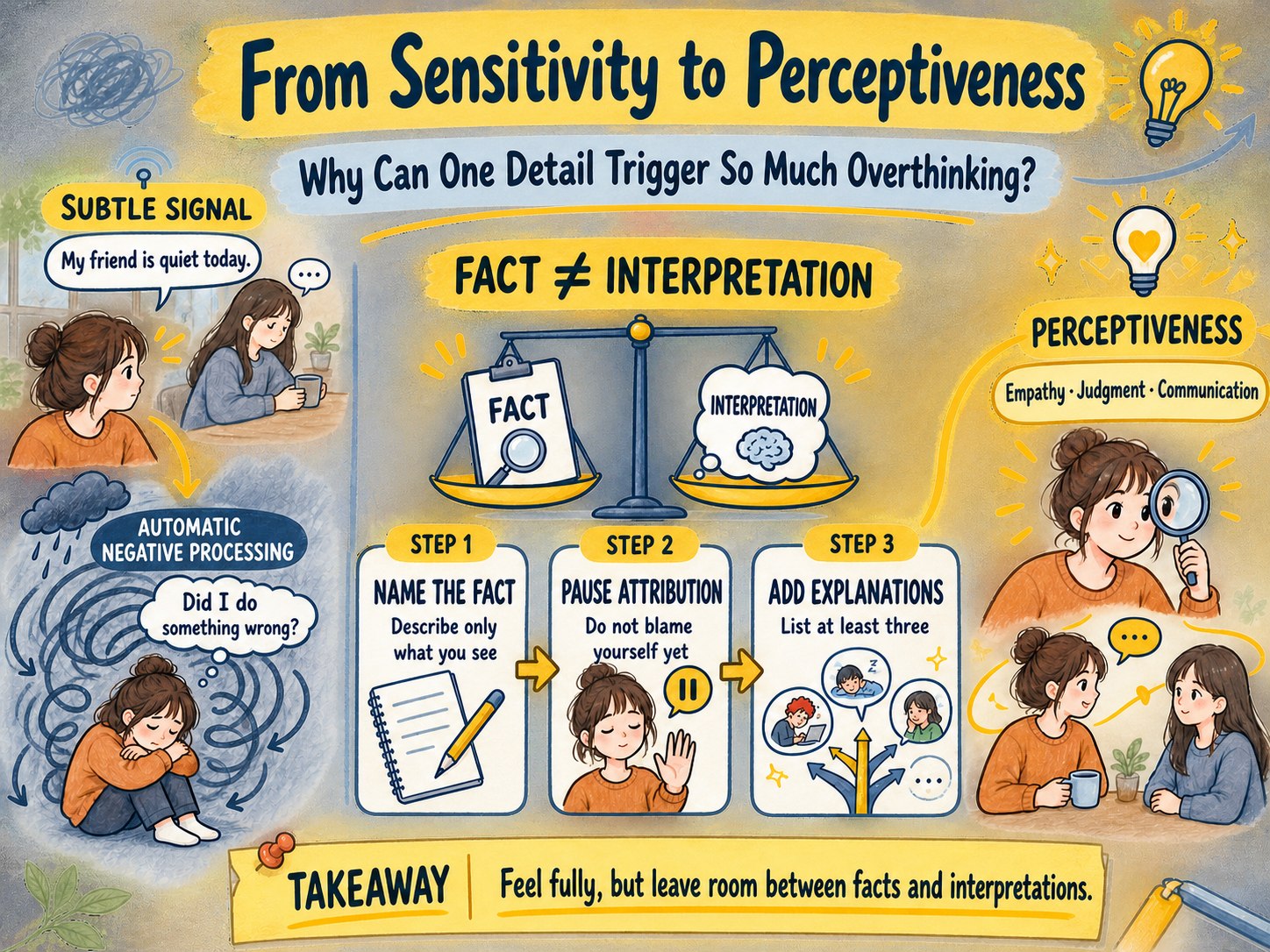
For example, when you notice a flash of impatience on a friend’s face, a sensitive reaction may be:
“Does this person dislike me?”
“Did I say something wrong?”
“Is our relationship getting worse?”
A perceptive reaction would be:
“I noticed that their expression changed.”
“This may or may not be related to me.”
“I can observe first, or confirm gently later.”
The first step from sensitivity to perceptiveness is to separate facts from interpretations.
The fact is: “My friend was quiet today.”
The interpretations are: “They dislike me.” “I made them uncomfortable.” “Our relationship is getting worse.”
Highly sensitive people often mix facts and interpretations together and treat their interpretations as facts. Therefore, the key to transformation is not to stop feeling, but to pause automatic interpretation after noticing something.
9. How Can We Break Automatic Negative Processing?
Many highly sensitive people may say, “I know I should not overthink, but deep processing happens automatically. Before I even realize it, I have already started thinking in a negative direction.”
This is indeed one of the greatest difficulties for highly sensitive people. The solution is not to force oneself to “stop thinking,” because the more one suppresses a thought, the more likely it is to return repeatedly. A more effective method is to increase the number of possible explanations.
When someone suddenly becomes quiet, the first reaction may be:
“Did I say something wrong?”
At this point, there is no need to immediately deny this thought. Instead, one can add several alternative possibilities horizontally:
“Maybe they are just tired.”
“Maybe they remembered something personal.”
“Maybe they were already in a bad mood today.”
“Maybe they need some quiet time.”
“Maybe this has nothing to do with me.”
The purpose of doing this is not to prove that one is definitely not at fault, but to break the pattern of “one single negative explanation.” When the brain has only one explanation, it easily treats that explanation as the truth. When the brain has multiple explanations, emotions loosen, and judgment becomes more objective.
This method can be summarized in three steps:
Step 1: Name the Fact
Describe only the objective information.
For example:
“He replied more slowly today.”
“Her expression looked a little stiff just now.”
“The atmosphere in the meeting became quiet.”
Step 2: Pause Attribution
Do not immediately say, “It is because of me.”
For example, do not immediately enter thoughts such as:
“Am I not good enough?”
“Am I being disliked?”
“Am I going to be abandoned?”
Step 3: Add Explanations
List at least three possibilities.
For example:
“It may be related to me.”
“It may be related to their own condition.”
“It may simply be a temporary emotional change.”
“It may need to be confirmed later.”
Through this process, highly sensitive people do not lose their sensitivity. Instead, they transform sensitivity from an emotional reaction into information-based judgment.
10. What Can Perceptiveness Bring?
When highly sensitive people no longer interpret every detail as danger, their sensitivity can become an ability.
In interpersonal relationships, perceptiveness can help them care for others more gently. For example, when they notice that a friend is in a low mood, they no longer need to blame themselves or ask defensively, “Do you dislike me?” Instead, they can say:
“I feel like you are a little tired today. Do you want to rest?”
“You seemed a bit quiet just now. If you want to talk, I can listen.”
This kind of expression is not defensive; it is caring. It neither forces the other person’s emotions to be about oneself, nor ignores the other person’s state.
In teamwork, perceptiveness can help individuals identify problems in advance. For example, when team members become silent or the atmosphere of a meeting becomes tense, a perceptive person may adjust the communication style and ask:
“Are there any points we have not aligned on yet?”
“Should we first organize everyone’s thoughts?”
In personal growth, perceptiveness can also help individuals understand themselves more accurately. Highly sensitive people are often very aware of emotional changes. If they can use this ability for self-observation rather than self-attack, they can identify sources of stress, relational needs, and psychological boundaries earlier.
Therefore, perceptiveness can bring several benefits:
- Less meaningless self-blame
One no longer interprets all of others’ emotions as one’s own fault. - Better relationship quality
One can move from defensive confirmation to sincere care. - Improved communication ability
One can more easily notice misunderstandings, silence, and unspoken needs. - Stronger team coordination
One can detect shifts in atmosphere early and promote communication repair. - Protection of emotional energy
One no longer falls into repeated rumination over every small detail. - Preservation of the strengths of high sensitivity
One continues to have observation, empathy, and attention to detail, but is no longer controlled by them.
11. Conclusion: Sensitivity Is Not the Enemy; Automatic Negative Processing Is
High sensitivity is not a weakness that needs to be eliminated. According to research on SPS, high sensitivity is an information-processing trait with individual differences, partial genetic foundations, and possible evolutionary significance. It allows individuals to perceive the environment more easily, detect details, and understand others’ emotions. At the same time, it also makes individuals more prone to overstimulation, repeated thinking, and negative attribution.
Therefore, what highly sensitive people truly need to learn is not “how to stop being sensitive,” but how to process the information brought by sensitivity.
From sensitivity to perceptiveness, the key is not to evolve a new ability, but to take one less step into automatic negative processing:
I can notice, but I do not have to blame myself immediately.
I can observe, but I do not have to reach a conclusion right away.
I can feel that something has changed, but I do not have to interpret every change as danger.
When highly sensitive people can separate facts from interpretations and expand a single negative explanation into multiple possibilities, they can gradually move from being “people overwhelmed by information” to “people who can use information.”
Sensitivity allows people to see more. Perceptiveness allows them to understand themselves, others, and the world more accurately.
References
Aron, E. N., & Aron, A. (1997). Sensory-processing sensitivity and its relation to introversion and emotionality. Journal of Personality and Social Psychology.
Aron, E. N., Aron, A., & Jagiellowicz, J. (2012). Sensory processing sensitivity: A review in the light of the evolution of biological responsivity. Personality and Social Psychology Review, 16(3), 262–282.
Lionetti, F., Aron, A., Aron, E. N., Burns, G. L., Jagiellowicz, J., & Pluess, M. (2018). Dandelions, tulips and orchids: Evidence for the existence of low-sensitive, medium-sensitive and high-sensitive individuals. Translational Psychiatry.
Assary, E., Zavos, H. M. S., Krapohl, E., Keers, R., & Pluess, M. (2021). Genetic architecture of Environmental Sensitivity reflects multiple heritable components: A twin study with adolescents. Molecular Psychiatry.