At the Turning Point of an IT Paradigm Shift
The IT industry is undergoing an unprecedented paradigm shift. There was a time when developers worked from back offices and wrote code from requirements documents. That era is ending. The space available to the “back-office coder” is shrinking as IT enters an age of frontline value creation.
Global technology companies are placing enormous bets on this transition. According to public market reports, Amazon has announced a $1 billion investment in building related roles and developing talent. Microsoft has also launched its $2.5 billion “Microsoft Frontier Company” initiative, with plans to deploy roughly 6,000 specialists directly to customer sites to co-design and implement AI systems.
These investments send a clear signal: technical output alone cannot bridge the gap between AI deployment and business results. Companies urgently need practitioners who can enter the customer’s environment and solve the last-mile problems of AI and systems implementation. Against this backdrop, the Forward Deployed Engineer, or FDE, is becoming one of the most closely watched roles in Silicon Valley and the global IT industry.
A Closer Look: What Is an FDE?
The Origin and Core Definition of the Role
The term “FDE” originated at Silicon Valley company Palantir Technologies. “Forward deployed” carries a distinctly military flavor, referring to technical specialists sent to the front line to solve problems in real operating conditions. Within Palantir, this role has also been associated with the name “Delta.”
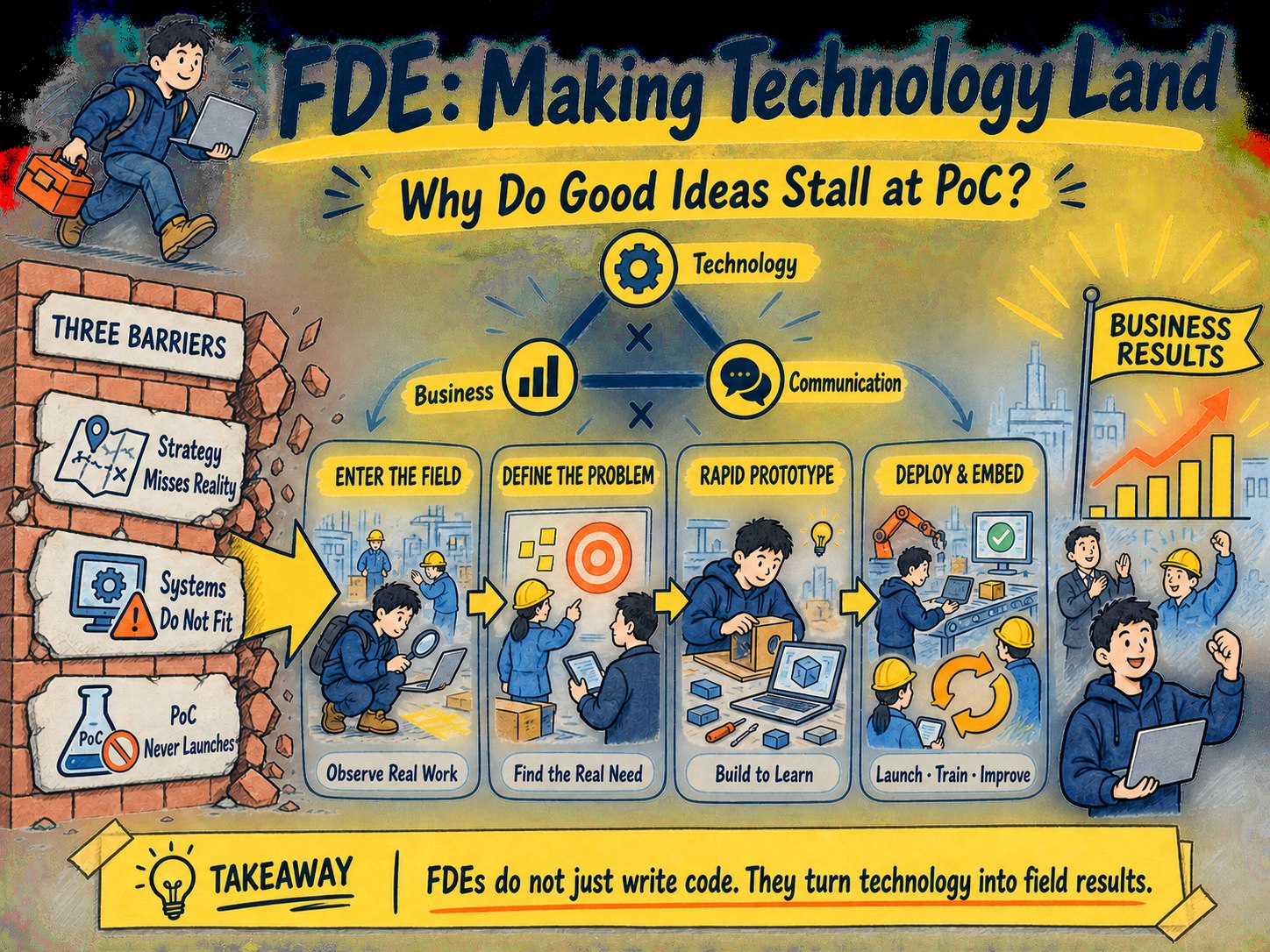
The Japan FDE Association, or JFA, defines the essence of the role as entering the field, discovering the real problem, building a prototype, and ensuring adoption. An FDE does not wait in an office for a requirements document. They embed themselves in business operations and use technology to address the problem at its source.
How FDEs Differ from Traditional Roles
| Dimension | FDE | SE | SES | IT Consultant | PM |
|---|---|---|---|---|---|
| Position | Deeply embedded at the customer site | Office or operations side | Instruction-driven labor | External observer | Schedule and risk control |
| Coding | Builds and validates directly | Implements from detailed designs | Completes assigned tasks | Rarely writes code | Rarely writes code |
| Problem definition | Actively discovers and defines problems | Receives requirements | Executes predetermined tasks | Analyzes and advises | Receives business requests |
| Primary output | Problem resolution and business results | A delivered system or application | Billable time and headcount | Reports and presentation decks | Plans and status reports |
Compared with SEs and PMs: A traditional systems engineer often begins after the requirements are finalized. An FDE helps define those requirements. I once led a system project worth ¥100 million, working with eight developers and more than twenty stakeholders. By making decisions in the field and reducing unnecessary requirements, I resolved conflict between departments and achieved 180% of the profit target.
Compared with IT consultants: Consultants are skilled at setting strategy through presentations, but their work often stops at recommendations. An FDE crosses the “implementation valley” and turns the concept into production code.
Compared with SES personnel: SES is fundamentally oriented around billable time. An FDE is a value-oriented partner. Rather than simply taking instructions, the FDE works alongside the customer as a technical counterpart.
Is an FDE Just a General-Purpose Fixer?
Absolutely not. An FDE may appear to do everything, but the role is fundamentally a three-way translator across technology, business, and people. It demands unusual range: the ability to discuss architecture with a CTO and explain ROI to frontline staff. The FDE is the link that turns technology into measurable business value.
The Business Case: Why Do Companies Need FDEs Now?
Breaking Down the Three Barriers to Digital Transformation
- Strategy is disconnected from execution: Executive plans fail to become tools that frontline teams can actually use.
- Systems do not fit the field: Software is built without regard for real operating habits and eventually sits unused.
- Projects get trapped in PoC: The work remains a proof of concept forever and never reaches production.
The Core Advantage: Mastering Eight Domains
An FDE’s value is not limited to writing code. It also comes from owning the four domains that conventional development frequently overlooks. The Japan FDE Association organizes the role into an eight-domain model.
The First Four Visible Domains: Development and Design
- Field research and process mapping: Observe the real workflow in depth.
- AI-enabled process improvement: Integrate AI into a specific business setting.
- Application, workflow, and data design: Build the technical architecture.
- Prompt, RAG, and agent design and evaluation: Implement the core AI engineering layer.
The Four Less Visible Domains: Security, Compliance, and Continuity
- Information security, permissions, and logging: Keep data movement controlled and compliant.
- Internal controls, separation of duties, and audit: Meet enterprise governance requirements.
- Reducing key-person dependency and delivering documentation: Ensure the system can operate without relying on one individual.
- Field training, adoption, and continuous improvement: Stay with the customer until the system delivers lasting value.
Advanced Guide: How to Become a Capable FDE
The Three Core Capabilities
- Technical ability: Build prototypes with AI, low-code tools, or rapid programming techniques.
- Business understanding: Think in terms of ROI, understand basic finance, and grasp how the business works.
- Communication and interpersonal ability: Translate across levels, functions, and areas of expertise.
The FDE’s Essential Tool: Agile Prototyping
FDEs define the solution while building it, using rapid iterations to converge on the right requirements. Prototypes can be divided into three levels:
Paper Prototype
Use a whiteboard, process map, or sketch to confirm the business direction.
No-Code Prototype
Let the customer interact with and validate the proposed experience.
Code Prototype
Validate the core API and technical feasibility, then rebuild it properly.
This requires the courage to throw work away. A prototype is a validation tool, not a foundation. Once the assumption is tested, rewrite decisively instead of turning experimental code into long-term technical debt.
The Architect’s Decisive Question
“If this feature did not exist, would the business stop?”
This question can reduce redundant requirements to less than 40% of the original scope and dramatically improve ROI.
Career Milestones: The FDE Certification System
The Japan FDE Association’s Competency Ladder
JFA has established a professional certification system ranging from Level 5, Assistant, to Level 1, Architect. It provides a clear path from supporting project execution to taking responsibility for system architecture.
The Entry Ticket: Level 3 FDE Practitioner
Level 3 is considered a valuable entry credential because it assesses more than technical skill. It demonstrates the ability to independently lead an entire project lifecycle.
The certification confirms that a practitioner can complete the full loop: observe the field, define the problem, build a prototype, deploy the solution, and ensure adoption. For a small or medium-sized company, or a single business unit, a Level 3 FDE can already serve as an independent core contributor.
A Practical Next Step
To assess your potential, JFA offers a two-minute skills diagnostic. Its ten dimensions can quickly reveal gaps in business analysis, security and compliance, or AI engineering.
Move to the Front Line and Help Define the Future
The evolution of the IT professional is irreversible. Instead of waiting passively for instructions in the back office, we can become frontline creators of value. FDE is more than a title. It represents the ambition of technologists to return to the center of business and shape what comes next.
The front line is calling. Are you ready?
Source Note
The definitions, competency levels, eight-domain model, and related methods in this article were compiled from public materials and research published by the Japan FDE Association. Investment figures and business plans were compiled from publicly reported market information.